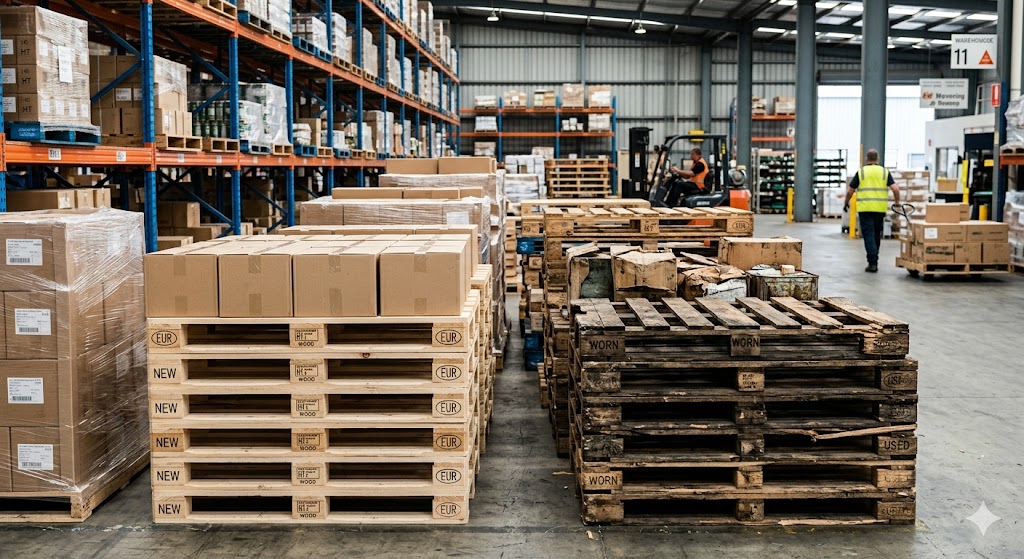
Pallet Solutions for Every Industry
Every industry has distinct pallet requirements driven by product characteristics, regulatory standards, handling conditions, and supply chain rhythms. At Pallets West Coast, we do not offer one-size-fits-all solutions. We design pallet programs around the specific demands of your sector, drawing on over a decade of experience serving businesses across the Pacific Northwest from our facility at 1875 W 6th Ave, Eugene, OR 97402.
From FDA-compliant food-grade pallets to heavy-duty platforms for construction materials, from automation-compatible precision pallets to export-ready heat-treated solutions, we have the inventory, expertise, and service infrastructure to support your operation.
Get an Industry-Specific Quote
Tell us about your industry and volume, and we will build a pallet program tailored to your exact requirements.
Jump to Your Industry
Eight Sectors, One Expert Partner
Industry Focus
Food & Beverage
The food and beverage industry operates under some of the most stringent regulatory requirements in the supply chain, and pallet selection is a critical compliance factor that many businesses overlook. At Pallets West Coast, we understand that every pallet entering a food production facility, cold storage warehouse, or distribution center must meet FDA Food Safety Modernization Act (FSMA) standards. Our food-grade pallets are inspected for splinters, protruding nails, chemical contamination, and structural integrity before they ever reach your loading dock. We maintain strict chain-of-custody documentation so you can demonstrate compliance during audits.
Cold chain logistics present unique challenges for pallet performance. Temperature fluctuations between frozen storage, refrigerated transport, and ambient receiving docks cause wood to expand and contract, weakening joints over time. We select kiln-dried hardwood and softwood species with proven dimensional stability for cold chain applications, and our repair technicians reinforce critical stress points with ring-shank nails that resist pullout in freeze-thaw cycles. For facilities that require ISPM-15 heat-treated pallets for international export of food products, our certified kilns process pallets to the required 56 degrees Celsius core temperature with full data logging for regulatory traceability.
Hygiene is non-negotiable in food environments. Unlike chemical fumigation methods that leave residues, our heat treatment process uses only dry thermal energy, producing pallets that are safe for direct contact with food packaging. We offer Grade A recycled pallets that are visually clean, structurally sound, and free of staining or odor, making them ideal for retail-facing food distribution where appearance matters. For ultra-sensitive applications like dairy, bakery, and fresh produce, we also supply new pallets built from fresh-sawn lumber with no prior use history.
Our food and beverage clients include regional produce distributors, frozen food manufacturers, craft beverage companies, and national grocery distribution centers across Oregon, Washington, and California. We offer recurring weekly delivery programs that align with your production schedules, and our free removal service keeps your dock clear of empties and damaged pallets. Whether you need 100 pallets a week for a local bakery or 5,000 a week for a major distribution hub, our inventory depth and delivery infrastructure are built to serve the food industry reliably.
Recommended Products & Services
Industry Focus
Pharmaceutical
Pharmaceutical manufacturing and distribution demand the highest standards of contamination control, traceability, and consistency in packaging materials, including the pallets that carry raw ingredients, finished drugs, and medical devices through the supply chain. Pallets West Coast provides pharmaceutical-grade pallet solutions that align with Current Good Manufacturing Practice (cGMP) requirements and support your facility qualifications under FDA 21 CFR Part 211. Every pallet we supply for pharmaceutical applications undergoes enhanced inspection protocols that go beyond standard grading.
Contamination control starts with material selection and handling. For pharmaceutical clients, we maintain a segregated inventory of pallets that have never been used in chemical, agricultural, or waste-handling applications. Each pallet is visually inspected for mold, pest evidence, chemical staining, and foreign material before being approved for pharmaceutical use. Our heat treatment process eliminates biological contaminants without introducing chemical residues, and we provide batch-level treatment certificates that tie directly to your lot tracking systems.
Traceability is a core requirement in pharmaceutical logistics, and we support it at the pallet level. Every pharmaceutical-grade pallet we ship is documented with date of inspection, grade classification, treatment status, and delivery destination. This documentation integrates seamlessly with your warehouse management system and provides an auditable trail from our facility to your receiving dock. For clients requiring unique identification, we offer stenciling, branding, and barcode labeling services that allow individual pallet tracking through your distribution network.
Our pharmaceutical clients range from compounding pharmacies and biotech startups in the Portland metro area to large-scale drug manufacturers and medical device distributors across the West Coast. We understand that production line stoppages due to pallet supply issues are unacceptable in this industry, which is why we maintain dedicated safety stock for pharmaceutical accounts and offer priority delivery with guaranteed same-day or next-day turnaround. Our dedicated account managers for pharmaceutical clients are trained in industry-specific requirements and serve as your single point of contact for all pallet needs.
Recommended Products & Services
Industry Focus
Automotive
The automotive industry operates on just-in-time manufacturing principles where a single missing component can halt an entire assembly line, costing thousands of dollars per minute of downtime. Pallets in automotive supply chains must be engineered for heavy loads, precise dimensions, and absolute delivery reliability. Pallets West Coast serves automotive parts manufacturers, Tier 1 and Tier 2 suppliers, aftermarket distributors, and dealership logistics operations with heavy-duty pallet solutions designed for the unique demands of this industry.
Automotive components vary enormously in size and weight, from small fastener kits weighing a few pounds to engine blocks, transmissions, and body panels that can exceed 2,500 pounds per pallet load. Our heavy-duty block pallets and reinforced stringer pallets are engineered with load capacities ranging from 2,500 to 5,000 pounds static and 2,000 to 3,500 pounds dynamic. For oversized components like hoods, bumpers, and exhaust systems, we build custom pallets with extended dimensions and integrated dunnage systems that protect parts during transit and simplify unloading at the assembly plant.
Just-in-time delivery is not a preference in automotive logistics; it is a requirement. Our scheduled delivery programs align with your production cadence, whether that means daily drops at a specific dock door at 5 AM or twice-weekly bulk deliveries coordinated with your material planning system. We maintain buffer stock for automotive accounts to absorb demand spikes without lead time delays. For suppliers shipping internationally, our ISPM-15 heat-treated pallets and export crating services ensure compliance at every border crossing.
We work with automotive businesses throughout the Pacific Northwest corridor, including parts manufacturers in the Portland industrial district, distribution centers along the I-5 corridor, and specialty fabricators in the Eugene-Springfield area. Our repair program is particularly valuable for automotive clients who receive inbound parts on pallets that can be refurbished and returned to the supply chain rather than discarded. This closed-loop approach reduces your pallet spend by 30 to 50 percent while supporting the sustainability reporting requirements that many automotive OEMs now mandate from their supply chain partners.
Recommended Products & Services
Industry Focus
Retail & E-Commerce
Retail and e-commerce fulfillment operations face pallet challenges that are fundamentally different from traditional manufacturing and distribution. Seasonal demand swings, high SKU counts, rapid inventory turns, and the need for clean, presentable pallets in retail-facing environments all create requirements that standard pallet suppliers struggle to meet. Pallets West Coast has built specific programs for retail and e-commerce clients that address these unique operational realities with flexible solutions designed to scale with your business.
Last-mile logistics and store delivery demand pallets that are not only structurally sound but also visually clean and free of splinters, staining, and protruding fasteners. Our Grade A recycled pallets meet these appearance standards at a fraction of new pallet cost, making them ideal for retail distribution centers that ship to stores where pallets may be visible to customers. For display pallet applications in club stores and big-box retailers, we offer custom-sized pallets built to specific merchandising dimensions with smooth deck surfaces suitable for direct product display.
Seasonal surge capacity is a defining challenge for retail and e-commerce businesses. Between Black Friday, holiday shopping, back-to-school, and seasonal product launches, your pallet needs can double or triple within a few weeks. Our inventory of over 50,000 pallets across all sizes and grades means we can absorb your peak demand without lead time surprises. We offer pre-season staging programs where we allocate dedicated inventory for your account beginning 30 days before your anticipated peak, with flexible scheduling that ramps up and down as your fulfillment volume dictates.
E-commerce fulfillment centers have specific pallet requirements driven by automated material handling systems. Pallets must be dimensionally consistent to work with conveyor systems, automated guided vehicles, and high-density racking. We provide precision-graded pallets that meet tight dimensional tolerances, ensuring compatibility with your warehouse automation infrastructure. Our free removal service is particularly valuable for e-commerce operations that receive enormous volumes of inbound freight on pallets that quickly accumulate and consume valuable floor space. We pick up your empties on the same truck that delivers your fresh supply, keeping your dock clear and your operation running efficiently.
Recommended Products & Services
Industry Focus
Agriculture
Oregon and the Pacific Northwest are home to some of the most productive agricultural regions in the United States, from Willamette Valley vineyards and orchards to Eastern Oregon grain operations and the coastal dairy and seafood industries. Agricultural pallets face conditions that would destroy standard warehouse pallets within a single season: exposure to rain, irrigation water, field mud, sun, and the biological moisture of fresh produce. Pallets West Coast has served agricultural operations since our founding, and we understand the specific material, timing, and compliance requirements that make farming and food production unique.
Field pallets used in harvest operations need moisture resistance, structural toughness, and affordability because they take a beating. We supply Grade B and Grade C recycled pallets for field use at prices that make economic sense even for single-use applications like moving produce from field to packing house. For operations that stack pallets outdoors in all weather, we recommend hardwood stringers with softwood deck boards, a combination that balances durability with cost. Our repair program extends the life of field pallets by replacing broken boards and reinforcing weakened joints, giving you two to three additional seasons from pallets that would otherwise be discarded.
Produce shippers face strict phytosanitary requirements when exporting to international markets. Our ISPM-15 heat treatment certification is essential for agricultural exporters shipping to Asia, Europe, South America, and virtually every international destination. We process agricultural pallets through our certified kilns with full documentation including treatment date, batch number, temperature records, and the official ISPM-15 stamp. For specialty crops like hazelnuts, grass seed, berries, and hops that are major Oregon exports, we provide export-ready pallets in both standard GMA sizes and the custom dimensions required by international buyers.
Timing in agriculture is dictated by nature, not by purchase orders. When harvest hits, you need pallets delivered to your packing house immediately, not in five business days. We maintain pre-season agreements with agricultural clients that guarantee inventory allocation and priority delivery during harvest windows. Our delivery routes cover the entire Willamette Valley, the Rogue Valley, Central Oregon, and points north into Washington, ensuring that your operation receives pallets when the crop is ready, not when the supply chain catches up. We also pick up empties and damaged pallets from packing houses and cold storage facilities at no charge, keeping your operation clean and compliant.
Recommended Products & Services
Industry Focus
Construction & Building Materials
Construction and building materials represent some of the heaviest and most dimensionally challenging loads in the pallet industry. Concrete pavers, roofing bundles, steel studs, bags of cement, bricks, tile, and engineered lumber products all demand pallets that can withstand extraordinary static loads without deformation, splitting, or collapse. At Pallets West Coast, we supply heavy-duty pallets engineered for the construction sector, including reinforced block pallets rated for static loads up to 6,000 pounds and custom-dimensioned platforms for oversized materials.
Construction job sites present handling conditions that are far harsher than a climate-controlled warehouse. Pallets are set down on gravel, mud, and uneven ground. They are exposed to rain, snow, and direct sun. Forklifts on job sites often lack the precision of warehouse equipment, leading to rough handling and fork damage. We address these realities by supplying pallets built with hardwood stringers, thicker deck boards, and additional fasteners at stress points. For one-time-use applications like concrete block delivery, we offer economical Grade C recycled pallets that provide the necessary load support at the lowest possible cost.
Oversized building materials like sheet goods, I-joists, and structural steel often exceed standard 48x40 pallet dimensions. Our custom pallet manufacturing capability produces pallets in any dimension up to 8 feet by 8 feet, with engineered load ratings calculated for your specific product weight and handling method. We work with building material distributors, lumber yards, masonry suppliers, and roofing contractors to design pallet specifications that protect their product during transport and storage while remaining compatible with their delivery equipment and customer receiving capabilities.
Construction is a project-based industry, and pallet needs fluctuate dramatically with the building cycle. A single commercial project might require 500 heavy-duty pallets for a two-week window, then nothing for months. We accommodate project-based ordering with short lead times, no minimum order penalties, and flexible delivery scheduling that works around your job site timelines. Our free removal service is especially valuable for construction sites where pallet accumulation creates safety hazards and takes up space needed for materials staging. We pick up used and damaged pallets from job sites, lumber yards, and material distribution centers across our service area.
Recommended Products & Services
Industry Focus
Manufacturing
Modern manufacturing facilities increasingly rely on automated material handling systems including conveyors, automated storage and retrieval systems (AS/RS), automated guided vehicles (AGVs), and robotic palletizers. These systems require pallets that meet tight dimensional tolerances, consistent weight specifications, and specific design characteristics such as four-way entry, flush deck surfaces, and uniform stringer or block placement. Pallets West Coast supplies automation-compatible pallets for manufacturing operations across the Pacific Northwest, with precision grading that ensures every pallet performs predictably in your automated environment.
Dimensional consistency is not optional in automated manufacturing. A pallet that is a half-inch too wide will jam a conveyor, a pallet with a warped deck board will cause a robotic palletizer to misplace product, and a pallet with inconsistent block height will fail in an AS/RS system. Our inspection process for manufacturing clients includes dimensional verification using calibrated measuring tools, with rejection of any pallet that falls outside your specified tolerances. We document and communicate our dimensional accuracy rates so you can factor pallet reliability into your overall equipment effectiveness calculations.
Manufacturing environments also demand custom pallet sizes that match specific product dimensions, production line layouts, and shipping container configurations. Standard 48x40 GMA pallets serve many applications, but electronics manufacturers, appliance producers, paper mills, and specialty chemical operations often require non-standard dimensions. Our in-house manufacturing capability produces custom pallets from new lumber in any size, with engineering analysis available for load rating verification. We maintain custom pallet programs where your specific design is kept in production and inventory, ready for delivery on your regular schedule.
For manufacturers with high pallet throughput, our combined delivery and removal program creates a closed-loop pallet supply chain. We deliver fresh pallets on a recurring schedule and simultaneously remove empties, damaged pallets, and end-of-life units from your facility. This approach eliminates pallet accumulation on your production floor, reduces your waste hauling costs, and provides a consistent stream of affordable recycled pallets back into your operation. Our repair service further extends the lifecycle of pallets in your system, with on-site repair available for high-volume manufacturing clients who process thousands of pallets per week.
Recommended Products & Services
Industry Focus
Breweries & Wineries
Oregon is home to over 300 wineries and 350 craft breweries, making it one of the most vibrant beverage production regions in the country. Pallets West Coast has deep experience serving the unique needs of breweries, wineries, cideries, and distilleries throughout the Willamette Valley, the Portland metro area, and beyond. Beverage production facilities handle heavy, fragile products in glass and aluminum packaging that require pallets with excellent load distribution, smooth deck surfaces to prevent case damage, and consistent dimensions for automated packaging lines.
Barrel handling is a specialized pallet application that is central to wine, spirits, and barrel-aged beer production. Standard wine barrels weigh approximately 600 pounds when full, and barrel storage racks often stack three to four barrels high. We produce barrel pallets with reinforced center stringers, wider deck boards for stable barrel cradling, and load ratings engineered for the concentrated weight of full barrels. For wineries that export barrels or bottled wine internationally, our ISPM-15 heat treatment certification ensures your wood packaging meets phytosanitary requirements in every destination market, from the European Union to Japan and Australia.
Craft beverage producers face a unique challenge: their production volumes are large enough to require commercial pallet quantities but often too small to attract the attention of large national pallet suppliers. We specialize in serving this middle market with the personalized service of a local supplier and the inventory depth to handle your production peaks. Whether you are a startup brewery packaging 500 cases a month or an established winery shipping 50,000 cases annually, we scale our delivery and pricing to match your actual production volume without imposing rigid minimum orders or long-term contracts.
Many of our brewery and winery clients participate in our pallet return program, where we pick up empty pallets from retail distribution points and tasting rooms, repair them as needed, and return them to your production facility for reuse. This circular approach reduces your per-pallet cost by 40 to 60 percent compared to buying new pallets for every production run. We also supply specialty items like reclaimed wood for tasting room decor, event signage, and retail displays, connecting our recycled material stream with the creative aesthetic that defines Oregon craft beverage culture.
Recommended Products & Services
The Pallets West Coast Advantage
Why Industry-Specific Pallet Solutions Matter
Regulatory Compliance
Different industries face different regulatory frameworks. FDA, USDA, OSHA, ISPM-15, and cGMP all impose specific requirements on packaging materials. A pallet that is perfect for a warehouse may be non-compliant in a pharmaceutical facility. We match the right pallet to your regulatory environment.
Load Performance
A 20-pound consumer product and a 2,500-pound engine block require fundamentally different pallet engineering. We assess your actual load characteristics and recommend pallet specifications that provide safe, reliable support without over-engineering that wastes your budget.
Handling Conditions
Climate-controlled warehouses, outdoor construction sites, frozen storage, and automated conveyor systems all subject pallets to different stresses. We select materials and construction methods that match your specific handling environment for maximum lifespan.
Cost Optimization
The cheapest pallet is not always the most cost-effective pallet. We help you find the sweet spot between pallet quality, lifecycle cost, and operational reliability so that your pallet program delivers the best total value for your specific application.
Comprehensive Comparison
Industry-Specific Pallet Requirements
Every industry has unique pallet requirements driven by product weight, regulatory environment, handling conditions, and supply chain rhythm. This reference table compares the key criteria across all eight industries we serve, helping you understand exactly what specifications matter most for your sector.
| Industry | Load Capacity Static lbs | Primary Grade Recommended | Heat Treatment ISPM-15 | Moisture Tolerance | Dimensional Precision | Avg. Cost Per Pallet |
|---|---|---|---|---|---|---|
| Food & Beverage | 2,500 | Grade A | Required | Low (KD) | Standard | $6.50 - $12.00 |
| Pharmaceutical | 2,000 | Grade A / New | Required | Very Low | High | $9.00 - $15.00 |
| Automotive | 3,500 - 5,000 | Grade A / Heavy | Export Only | Standard | High | $8.00 - $18.00 |
| Retail & E-Commerce | 2,500 | Grade A / B | Optional | Standard | High (Auto) | $5.00 - $9.00 |
| Agriculture | 2,500 | Grade B / C | Export Only | High | Standard | $3.50 - $7.00 |
| Construction | 4,000 - 6,000 | Grade B / Heavy | Rare | High | Low | $4.00 - $14.00 |
| Manufacturing | 2,500 - 3,500 | Grade A / Custom | Varies | Low | Very High | $6.00 - $13.00 |
| Breweries & Wineries | 3,000 | Grade A / New | Export Only | Standard | Standard | $5.50 - $11.00 |
Regulatory Landscape
Compliance Requirements by Industry
Pallet compliance is not optional. Failing an audit, receiving a citation, or having a shipment rejected at a border crossing can cost your business thousands. Here is a detailed breakdown of the regulatory requirements that apply to each industry we serve and how Pallets West Coast helps you stay compliant.
Food & Beverage
Risk: HighFDA FSMA, USDA Organic Standards, SQF/BRC Audit Requirements
Food-contact pallets must be free of chemical contamination, mold, and pest evidence. FSMA requires documented supplier controls for all packaging materials. SQF and BRC audits specifically evaluate pallet condition and sourcing. We provide chain-of-custody documentation, batch treatment certificates, and visual-clean Grade A pallets that pass every major food safety audit.
Non-Compliance Risk: FDA warning letters, product recalls, loss of retail shelf space
Pharmaceutical
Risk: CriticalFDA 21 CFR Part 211, cGMP, WHO GDP Guidelines
Pharmaceutical pallets must meet Current Good Manufacturing Practice standards including segregated handling, traceability documentation, and contamination-free materials. WHO Good Distribution Practice guidelines extend these requirements through the entire distribution chain. We maintain segregated pharmaceutical pallet inventory with batch-level traceability.
Non-Compliance Risk: FDA 483 observations, consent decrees, product seizure
Automotive
Risk: HighIATF 16949, OSHA 1910.176, DOT Load Securement (49 CFR 393)
Automotive supply chains often require IATF 16949-compliant packaging suppliers. OSHA mandates safe material handling practices including proper pallet loading and stacking. DOT regulations govern load securement during transport. Our heavy-duty pallets meet load rating requirements and our documentation supports your quality management system.
Non-Compliance Risk: Assembly line shutdowns, OSHA citations, customer deductions
Agriculture / Export
Risk: CriticalISPM-15, USDA APHIS PPQ, EU Phytosanitary Directive 2000/29/EC
Any wood packaging material crossing international borders must comply with ISPM-15 heat treatment or methyl bromide fumigation standards. The USDA Animal and Plant Health Inspection Service enforces compliance for exports. Non-compliant shipments are refused entry, quarantined, or destroyed. Our certified kilns and stamping authority ensure every export pallet passes.
Non-Compliance Risk: Shipment refusal at port, quarantine fees, loss of export license
Retail & E-Commerce
Risk: MediumWalmart OTIF Standards, Amazon FBA Requirements, GS1 Pallet Standards
Major retailers impose strict On-Time In-Full requirements with financial penalties for non-compliance. Amazon FBA has specific pallet dimension, weight, and condition requirements that must be met for warehouse acceptance. GS1 standards define pallet footprint specifications for supply chain interoperability. We supply precision-graded pallets that meet every major retailer standard.
Non-Compliance Risk: Chargebacks, refused deliveries, suspended vendor status
Construction
Risk: MediumOSHA 1926 Subpart H, ANSI MH1, Local Building Code Requirements
Construction sites are governed by OSHA construction standards for material handling and storage. ANSI MH1 defines pallet design and testing standards for load-bearing applications. Local jurisdictions may impose additional requirements for materials used in public projects. Our heavy-duty pallets are engineered to meet or exceed rated load specifications.
Non-Compliance Risk: OSHA fines, job site injuries, project delays
Demand Intelligence
Seasonal Demand Patterns by Industry
Understanding when demand peaks is critical for pallet supply planning. We track seasonal patterns across all eight industries we serve so we can pre-position inventory and proactively manage your supply. Use this calendar to plan ahead and avoid costly shortages during your busiest periods.
| Industry | Jan | Feb | Mar | Apr | May | Jun | Jul | Aug | Sep | Oct | Nov | Dec | Peak Driver |
|---|---|---|---|---|---|---|---|---|---|---|---|---|---|
| Food & Bev | M | M | M | H | H | H | H | H | H | M | H | H | Holiday season, summer produce |
| Pharmaceutical | M | M | M | M | M | M | M | M | H | H | H | M | Flu season prep, year-end inventory |
| Automotive | M | M | H | H | H | H | M | M | H | H | M | L | Model year changeover, spring production ramp |
| Retail / E-Comm | L | L | M | M | M | M | H | H | H | H | H | H | Back-to-school, Black Friday, holiday |
| Agriculture | L | L | L | M | M | H | H | H | H | H | M | L | Harvest cycles Jun-Oct in PNW |
| Construction | L | L | M | H | H | H | H | H | H | M | L | L | Building season Apr-Sep |
| Manufacturing | M | M | M | H | H | M | M | M | H | H | M | L | Q2/Q3 production ramps, Q4 wind-down |
| Breweries | L | M | M | H | H | H | H | H | M | M | H | H | Summer sales, holiday gift packs |
Pre-Season Planning Tip
We recommend contacting us 30 to 60 days before your anticipated peak season to set up a pre-season inventory allocation agreement. This guarantees your pallet supply during the busiest months and locks in pricing before seasonal demand drives market rates higher. Over 70% of our managed-program clients use pre-season staging, and none have experienced a pallet shortage during peak periods. Our account managers can review your historical order data and recommend the optimal staging timeline for your specific industry and volume profile.
Cost Intelligence
Annual Pallet Cost Comparison by Industry
Understanding how pallet costs break down across different industries helps you benchmark your spending and identify savings opportunities. These figures represent typical annual pallet expenditure for mid-size operations in each sector within our service area.
| Industry | Avg. Monthly Volume | New Pallet Annual Cost | Recycled Pallet Annual Cost | Annual Savings | Savings Percentage |
|---|---|---|---|---|---|
| Food & Beverage | 800 | $115,200 | $62,400 | $52,800 | 46% |
| Pharmaceutical | 400 | $72,000 | $43,200 | $28,800 | 40% |
| Automotive | 600 | $129,600 | $57,600 | $72,000 | 56% |
| Retail & E-Commerce | 1,200 | $129,600 | $72,000 | $57,600 | 44% |
| Agriculture | 1,000 | $96,000 | $48,000 | $48,000 | 50% |
| Construction | 500 | $84,000 | $30,000 | $54,000 | 64% |
| Manufacturing | 700 | $109,200 | $54,600 | $54,600 | 50% |
| Breweries & Wineries | 300 | $39,600 | $21,600 | $18,000 | 45% |
$385,800
Average Combined Annual Savings
Across all 8 industries shown above
49%
Average Cost Reduction
By switching from new to quality recycled pallets
90 Days
Average Payback Period
Time for savings to offset transition costs
Expert Answers
Industry Pallet FAQ
Our team answers the most common questions we receive from businesses across all eight industries about pallet selection, compliance, cost optimization, and supply chain integration.
Can recycled pallets meet FDA food safety requirements?
Yes. Our Grade A recycled pallets are inspected for cleanliness, structural integrity, and contamination-free surfaces. They meet FDA FSMA requirements and pass SQF, BRC, and third-party food safety audits when properly selected and documented. We provide batch-level certificates confirming inspection date, grade, and treatment status for every food-grade shipment. Over 60% of our food industry clients use recycled pallets exclusively.
How do I know which pallet grade my industry requires?
Our industry-specific consultation process evaluates your product weight, handling environment, regulatory requirements, and customer specifications to recommend the optimal grade. Generally, pharmaceutical and food industries require Grade A or new pallets. Retail and manufacturing perform well with Grade A or B. Agriculture and construction often use Grade B or C for field and job-site applications. We provide free on-site assessments to match the right pallet to your exact application.
What is the cost difference between industry-specific pallets and standard pallets?
Industry-specific pallets may cost 10 to 40 percent more than generic standard pallets because they are selected, inspected, and documented to higher standards. However, the total cost of ownership is typically lower because industry-specific pallets reduce product damage, avoid compliance penalties, and last longer in their intended application. A pharmaceutical pallet that costs $12 versus a generic $8 pallet saves money if it prevents a single audit finding or product recall.
Do you offer pallet management programs for multi-location operations?
Yes. We serve multi-location operations across Oregon, Washington, and Northern California with centralized account management, coordinated delivery schedules, and consolidated billing. Your dedicated account manager oversees all locations from a single dashboard, ensuring consistent pallet quality and pricing across every facility. This is particularly valuable for food distributors, retail chains, and manufacturers with regional warehouse networks.
How far in advance should I plan for seasonal demand increases?
We recommend 30 to 60 days of lead time before your anticipated peak season. This allows us to pre-position inventory for your account, schedule additional delivery capacity, and lock in pricing before seasonal demand affects market rates. Agricultural clients should plan pre-harvest allocations by April for summer crops and by July for fall harvest. Retail clients should secure holiday inventory by September. Our seasonal demand calendar above provides specific timing guidance for your industry.
Can you supply both new and recycled pallets for the same operation?
Absolutely. Many operations use a mixed pallet strategy where new pallets serve customer-facing or compliance-sensitive applications while recycled pallets handle internal transfers, warehousing, and less regulated functions. This blended approach typically reduces total pallet costs by 30 to 45 percent compared to using new pallets exclusively. We can design a mixed-grade program tailored to your specific operational zones and requirements.
Your Industry, Our Expertise
Let Us Build a Pallet Program for Your Business
No matter your industry, we have the products, services, and experience to optimize your pallet operations. Contact us for a free consultation and custom quote.
1875 W 6th Ave, Eugene, OR 97402 · Mon–Fri 7 AM–5 PM · Sat 8 AM–12 PM